
BRIDGES Model for Intergroup Leadership

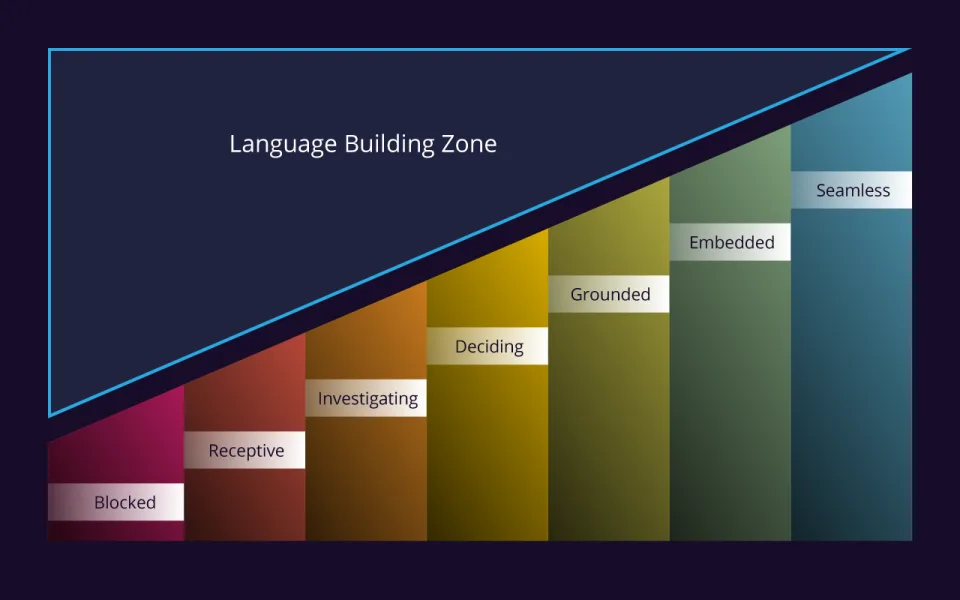
Leader language shapes group identity and affects how teams work together.
The language your leaders use with their team creates a group identity. Intergroup Leadership focuses on how to transform the language your leaders use so they can successfully build bridges between groups.
What it measures
Bridge-Building Behavior and Leader Language.
Bridge-Building Behaviors are the work you can see, such as building forums, group projects, and collaboration sessions. These are the activities that put groups in the same room. Leader Language is tougher because it's the language a group identifies with, and that drives how your teams work with each other. We apply our proprietary rubric to these two axes to determine where leaders sit on the BRIDGES model, from Blocked to Seamless.

What it consists of
Maturity measured against 10 dimensions.
Intergroup Leadership Maturity is measured on the BRIDGES model across ten dimensions using our proprietary rubric. The assessment results highlight the greatest areas of opportunity for your leaders and your organization. Our coaching is custom tailored to help your leaders develop the language and bridge-building behaviors that develop shared group identity and improve cross-boundary work.

Where it comes from
Built on the research that founded the field.
The BRIDGES Model for Intergroup Leadership is grounded in the seminal research conducted by Stanton Brooks, Ph.D.* His dissertation covered leader language and group identity in large U.S. organizations. The BRIDGES Model was cosigned by Dr. Brooks, and he authored the foreword to SILO is a Four-Letter Word. BRIDGES makes his research coachable.

Our frameworks are designed to work together.
The BRIDGES Model covers how leader language shapes group identity and affects working across groups. The remaining three evaluate how organizations build a culture of innovation and whether it takes hold, how they build the technical capability to use AI and the confidence to use it, and how they establish data readiness and the skills to benefit from it.
-
INSPIRE A model for innovation maturity — how organizations build the capacity for responsible risk, and why innovation fails without it.
-
CLIMB The AI readiness model — competence and confidence across cognitive, cultural and technical readiness, mapped to five levels.
-
IMPACT Covers how organizations establish their data readiness practices and the organizational skills needed to benefit from them.

Get the Book
The full BRIDGES Model for Intergroup Leadership, in one place.
* Stanton Brooks, Ph.D. is the father of Stanton M. Brooks II, the founder of Active Twist, and Dr. Brooks cosigned the development of the BRIDGES Model for Intergroup Leadership as a practical application of the findings from his dissertation research.

Discover where you are on the BRIDGES Model.
Take our 10 question Intergroup Leadership quiz. It's free and you get your results right away.